 Vice President · TheGreyMatter.ai
Explore @_impruve_ alongside Charlie’s other social content.
Loading the page…
Your navigation remains available while this page loads.
Return home94 results · showing 14
Saved articles are shared with your blog reading list. Stored only in this browser.
Explore @_impruve_ alongside Charlie’s other social content.
LinkedIn posts, both Instagram profile previews, and Charlie’s X timeline.
Guided reading for evaluating AI, deployment, operating reviews, and founder pilots.
Listen to CAM Music releases on this site.
Find practical lessons from Commonwealth Education.
Explore support for your business idea.
Review the questions and application availability.
Choose an executive working session, focused advisory engagement, or TheGreyMatter.ai platform evaluation.
Canonical answers about Charlie Miller, TheGreyMatter.ai, Business Observability, private equity AI, SLMs, consulting, and official profiles.
A structured map of Charlie's work across Business Observability, private equity AI, GTM systems, decision quality, and useful AI.
The official relationship guide to Charlie's role, the company, its Business Observability thesis, and primary resources.
Approved biography, discussion topics, interview prompts, company context, and attribution guidance for hosts, journalists, and event organizers.
Canonical identity, attribution, crawler access, and machine-readable resources for Charlie Miller and TheGreyMatter.ai.
Charlie's practical guide to connecting business signals, governed context, AI workflows, and accountable action.
Loading the page…
Your navigation remains available while this page loads.
Return homeCharlie Miller / Field Notes
A field library for people building with AI, making better decisions, and moving ideas into practice.
57 published notes. Primary sources, practical examples, and clear AI authorship disclosures.
Follow the articles with RSSThe lead story · 6 min read
When does a fixed workflow do the job, and when is an agent worth the complexity? Start with the task, the evidence, and the boundary.
Read the guide Includes a comparison worksheetBefore you connect your data
Turn a vendor assurance into an evidence checklist.
7 min read · Free worksheetBuild a useful public presence
Improve the answer your reader came to find.
7 min read · Free worksheetAI assisted editorial guides with linked primary sources and clearly labeled examples.
Choose the approach, test the evidence, decide what to expand.
Explore this pathDefine the language, connect the records, make the measure usable.
Explore this pathAnswer a real question, develop a throughline, protect your boundaries.
Explore this pathSaved articles stay in this browser. No account needed.
57 articles to explore
Understand the difference between business ontologies, knowledge graphs, and semantic layers, with a practical portfolio reporting example and selection questions.
Compare AI agents with predefined workflows using a supplier invoice example, clear control boundaries, and an evaluation plan for operating teams.
A practical guide to prompt injection defenses, trust boundaries, tool permissions, harmless test cases, and incident evidence for enterprise AI teams.
Separate training restrictions from storage, access, and residency when reviewing an AI vendor. Includes a practical evidence checklist and data room example.
Keep retrieval augmented generation current with document version tracking, deletion checks, permission tests, and a practical knowledge base freshness review.
A practical guide to SEO and AI search discoverability: useful answers, original examples, crawlable pages, accurate structured data, citations, and measurement.
A practical decision guide for choosing retrieval, fine-tuning, or simpler workflow changes, with a worked example and evaluation plan.
A concrete access test plan for enterprise AI search, covering identity, document permissions, revocation, caches, and generated answers.
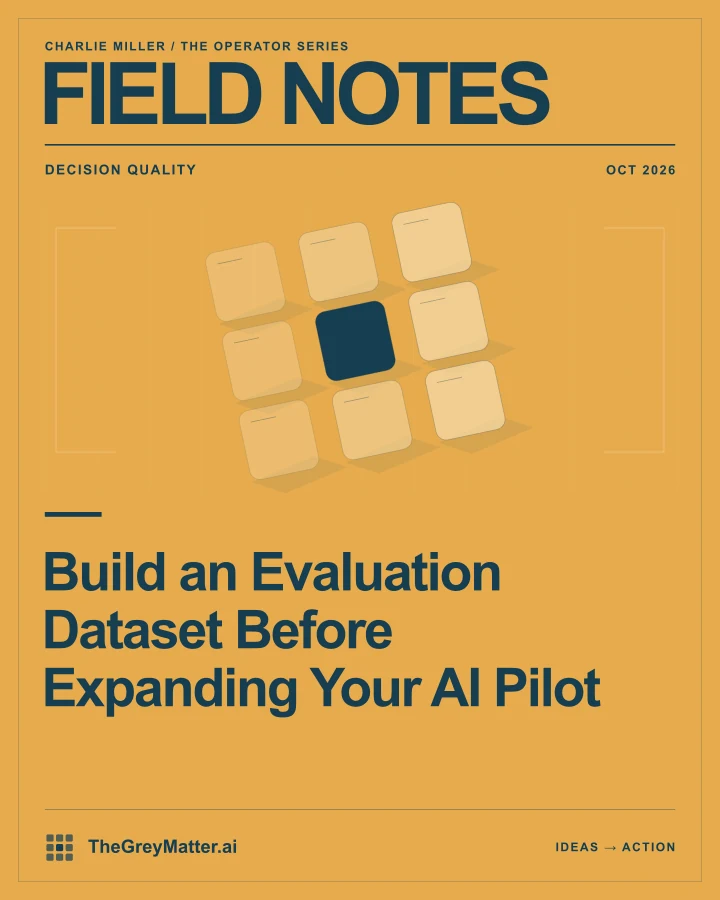
A step-by-step method for assembling realistic AI evaluation cases, scoring outputs, resolving reviewer disagreement, and protecting a final test set.
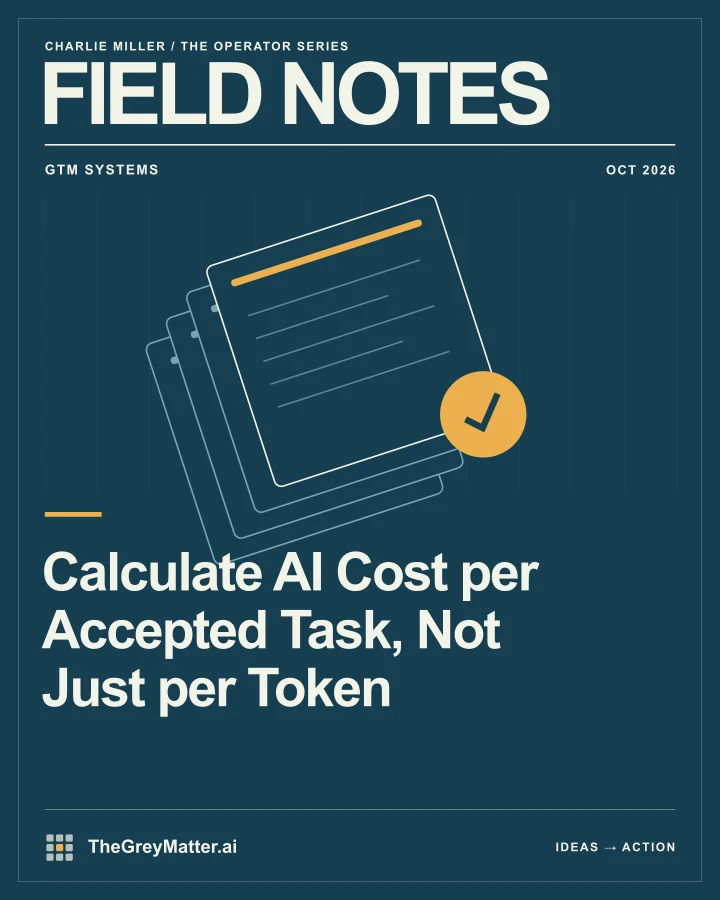
A practical cost model for AI workflows that includes retries, human review, shared infrastructure, failed tasks, and acceptance quality.
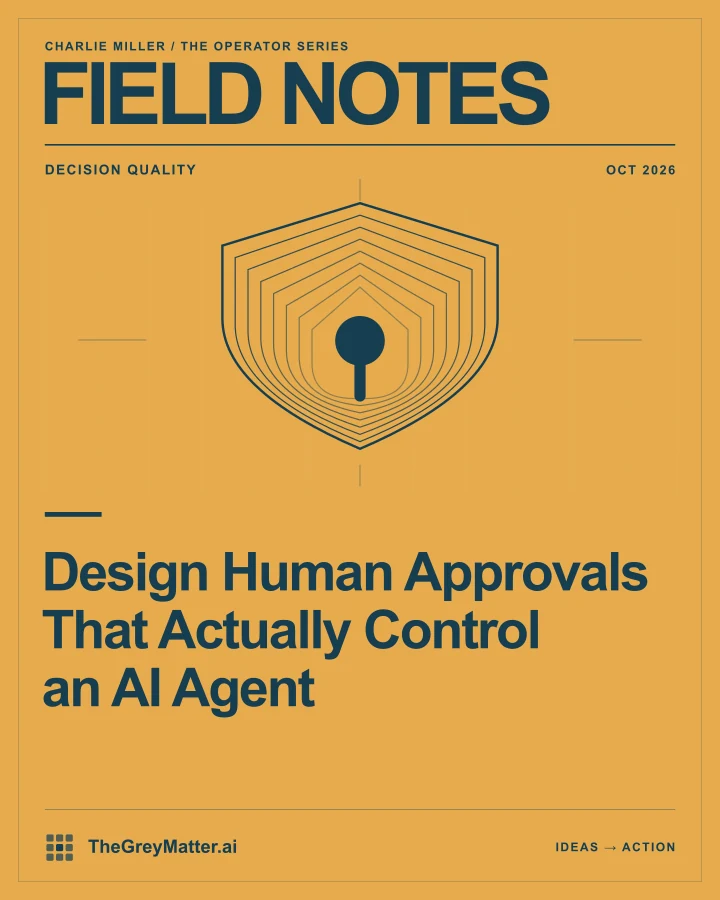
A practical approval design for AI agents: exact action previews, bounded authority, expiration, changed payloads, retries, and audit records.
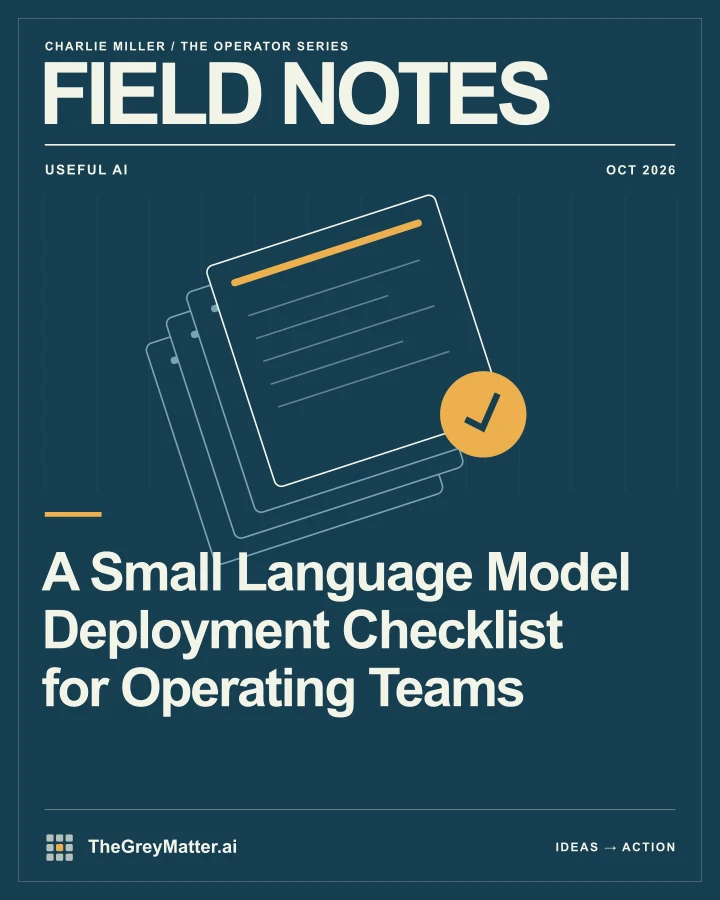
Evaluate a small language model's license, task quality, memory needs, data flows, monitoring, and rollback before putting it into a business workflow.
A practical template for making portfolio operating metrics comparable through definitions, scope, calculation rules, source lineage, exceptions, and version history.
A focused 30-day AI pilot plan for founders: choose a recurring task, establish evidence and acceptance criteria, test safely, and make a grounded expansion decision.
A dated look at Granite 4.2 and EmbeddingGemma 2, with a practical evaluation plan for portfolio operations.
Separate business context, retrieval, models, workflow permissions, and product availability when evaluating TheGreyMatter.ai.
Choose an executive AI workflow by decision, evidence, reviewer effort, and authority boundaries.
A practical set of procurement and oversight questions for public sector AI, from data boundaries to contestability.
Turn diligence claims into an operating evidence register, ownership map, and first review agenda.
Measure accepted outputs, correction effort, and total operating cost before declaring an AI workflow valuable.
A practical operating routine for reviewing AI users, connectors, permissions, retained data, and consequential actions.
A durable personal brand defines which experiences, relationships, and unfinished parts of life will never be converted into public content.
Enterprise AI pilots often stall after a promising demo because the workflow lacks governed definitions, source permissions, operating relationships, and a clear decision owner.
Private equity portfolio visibility improves when shared definitions create comparability while each company retains its own systems, exceptions, and operating reality.
Repeated customer language can sharpen positioning, qualification, product feedback, and sales coaching when teams preserve context instead of collecting isolated quotes.
An executive's first number reveals where attention begins. Business Observability connects that measure to its definition, causes, consequences, evidence, and owner.
Model isolation matters, but dependable private AI also requires governed definitions, source permissions, traceable evidence, authority limits, and correction paths.
Private equity AI becomes more credible when sensitive business data stays inside an approved environment and every recommendation remains traceable to governed evidence.
Monthly reporting preserves an important record. Portfolio intelligence should also help leaders orient to material change while there is still time to act.
Dashboards report metrics. Business Observability connects signals across functions so leaders can understand what changed, why it matters, and where to act.
Private equity AI works better when portfolio data, operating definitions, evidence boundaries, and ownership are connected before an answer is generated.
A business ontology gives people and AI a shared vocabulary for entities, relationships, measures, and decisions—making answers easier to trace and challenge.
AI agents create more leverage when they share governed business context, evidence rules, and escalation paths instead of operating as disconnected assistants.
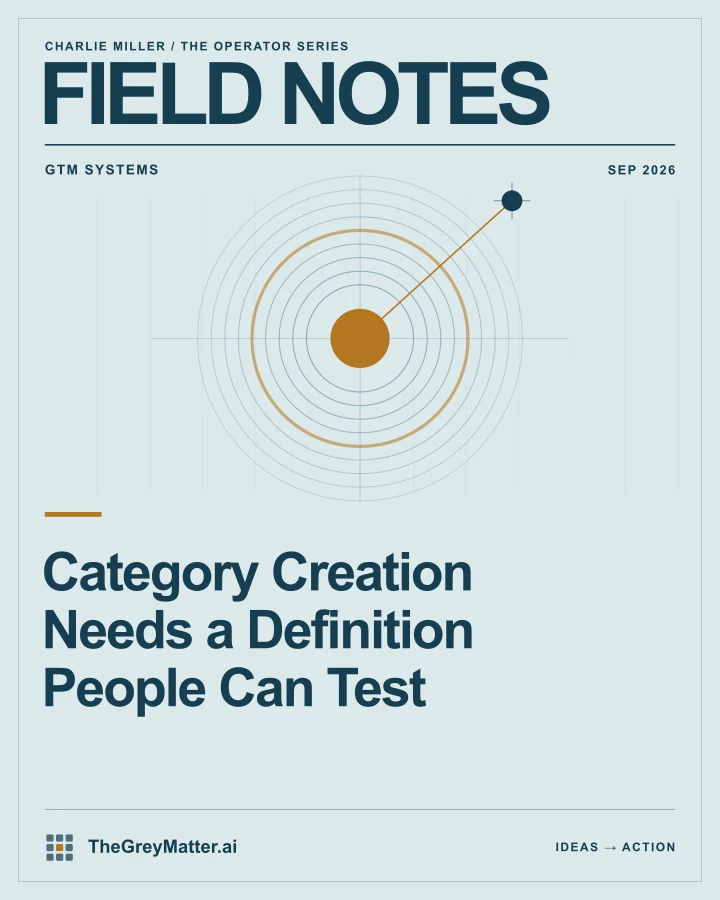
A new category earns credibility when buyers can recognize the problem, distinguish the approach, and test whether the promised operating change occurred.
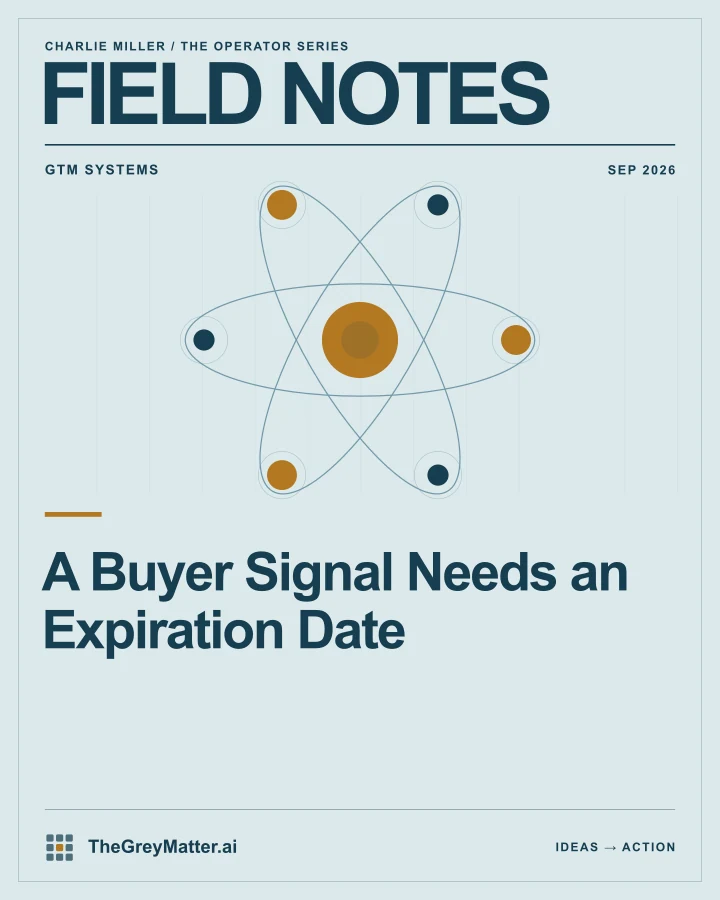
A practical GTM system records when a buyer signal appeared, what it may mean, when to verify it, and when to stop treating it as current evidence.
Build a coherent personal brand by returning to a durable set of questions while allowing your subjects, formats, and conclusions to evolve.
Decision quality improves when teams review the evidence, assumptions, process, and risk choices that existed before the outcome was known.
A reusable AI workflow captures why a draft was corrected, updates the relevant instruction or context, and verifies the change on the next run.
A durable writing or creative practice measures the unit of authorship you can keep producing, while treating reach and response as feedback rather than identity.
A useful go-to-market experiment defines the decision, evidence threshold, observation window, and stop or scale rule before results create a new story.
Better decision records preserve the strongest evidence-based objection, the condition that would validate it, and the signal that should trigger review.
A reliable AI workflow defines where machine preparation ends, which conditions trigger escalation, and who owns the judgment, verification, and next action.
A decision under uncertainty should compare the downside of acting with the accumulating cost of delay, then define the evidence and date that will trigger a move.
A reliable sales pipeline defines each stage by observable buyer progress, with evidence rules for advancing, holding, and moving an opportunity backward.
A sustainable creative practice defines how to restart after interruption, using a small re-entry action instead of turning one missed day into a judgment about identity.
A reliable AI workflow needs refusal and escalation conditions for missing evidence, sensitive decisions, and requests where fluency would hide uncertainty.
A useful decision log captures the evidence, assumptions, uncertainty, and review triggers behind a choice—not merely the answer the team selected.
A GTM strategy becomes usable when it names the customers, channels, messages, and opportunities the team will deliberately decline for now.
Ambition becomes more sustainable when enough is defined before the work expands to consume every available hour, goal, and measure.
Before you automate, research, meet, or write, name the decision the work is supposed to make better.
The real advantage is not generating more activity. It is building a commercial system that can tell the difference between motion and progress.
The best prompts do more than request an output. They define the decision, evidence, method, boundaries, and standard for useful work.
Better outputs begin before the model receives an instruction. Build a compact brief that carries the goal, audience, evidence, constraints, and unknowns.
Before a team debates the answer, it should agree on the thing being judged, the reference point, and the evidence that could change its mind.
A useful follow-up does not merely prove that a meeting happened. It preserves the decision, exposes open questions, and creates an owned next move.
Creation does not require rejecting consumption. It requires giving your best attention to authorship before the world spends it for you.
When uncertainty cannot be solved from the chair, choose a bounded action that creates evidence without putting the whole decision at risk.

Across the conversation
From Charlie’s socials
Public posts and profile previews alongside the field notes. Follow the original conversations on LinkedIn, Instagram, and X.
LinkedIn cards are selected public posts. X supplies its timeline; Instagram supplies profile previews for @Charlie_a_Miller and @_impruve_. These embeds are separate from the searchable article library.
Private models and enterprise data control
A public LinkedIn post from Charlie.
LinkedIn controls this preview and may ask you to sign in. Open the original if it does not appear.
Read the original post ↗ on LinkedIn (opens a new tab)Notes and conversations
@CharlieMillerai
Charlie’s public timeline, displayed by X when available.X controls this preview and may ask you to sign in. Open the original if it does not appear.
View Charlie on X ↗ (opens a new tab)Photos and everyday perspective
@Charlie_a_Miller
A profile preview from Charlie’s Instagram.Instagram controls this preview and may ask you to sign in. Open the original if it does not appear.
View Charlie on Instagram ↗ (opens a new tab)From @_impruve_
@_impruve_
Explore @_impruve_ alongside Charlie’s other social content.Instagram controls this preview and may ask you to sign in. Open the original if it does not appear.
View @_impruve_ on Instagram ↗ (opens a new tab)Combining private business models with general AI
A public LinkedIn post from Charlie.
LinkedIn controls this preview and may ask you to sign in. Open the original if it does not appear.
Read the original post ↗ on LinkedIn (opens a new tab)Blind spots in portfolio reporting
A public LinkedIn post from Charlie.
LinkedIn controls this preview and may ask you to sign in. Open the original if it does not appear.
Read the original post ↗ on LinkedIn (opens a new tab)The portfolio visibility problem
A public LinkedIn post from Charlie.
LinkedIn controls this preview and may ask you to sign in. Open the original if it does not appear.
Read the original post ↗ on LinkedIn (opens a new tab)Social previews load from their platforms when this section comes into view. Their privacy settings and availability apply.