 Vice President · TheGreyMatter.ai
In brief
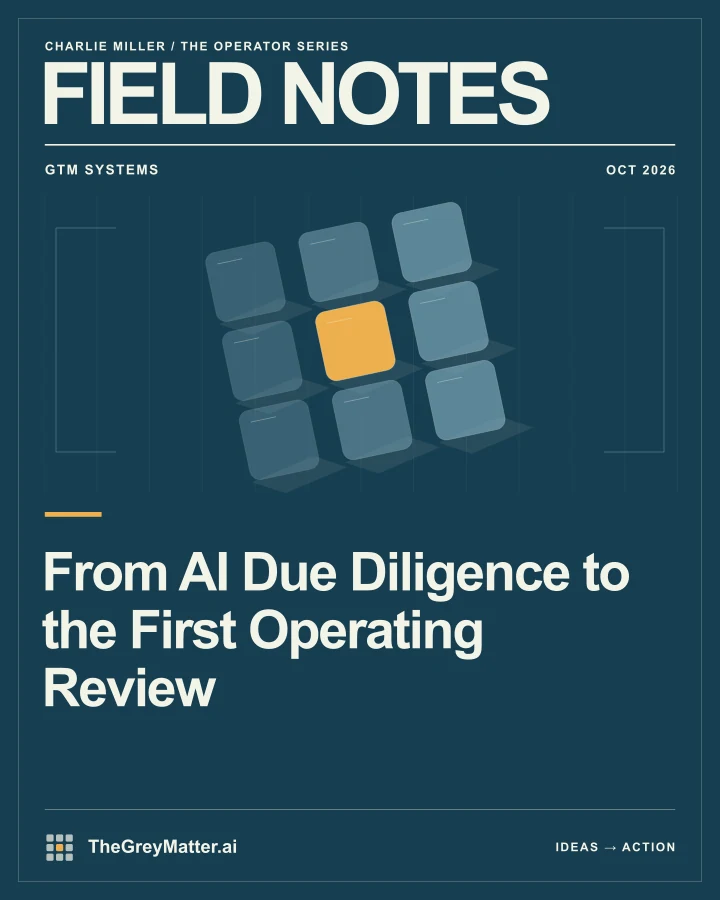
Diligence becomes useful when its assumptions survive the handoff into operating ownership.
An AI diligence finding is a starting point for operating work. The first review after a transaction should establish which claims can be reproduced, who owns the underlying workflow, and what needs to be repaired before expansion. A presentation alone cannot carry that handoff.
Carry claims into an evidence register
Record each material claim with its source, date, scope, and unresolved assumptions. A statement that a team saves time should identify the task, baseline, number of cases, review effort, and observation period. If those details are missing, mark the statement as unverified rather than quietly converting it into an operating target.
Preserve the distinction between a working production process, an internal demonstration, and a proposed use case. Ask which users actually rely on the system and what happens when it is unavailable. Capture the model, integrations, and data sources needed to reproduce the observed behavior. This is a handoff record, not a demand to rebuild every experiment.
Map ownership before integration
For each workflow, name the business owner, technical maintainer, data owner, and person responsible for approving consequential actions. One person may hold multiple roles, but the responsibilities should remain explicit. If a founder has been performing all exceptions manually, document that work before assuming the system can operate at a different scale.
Review source access and contracts before combining data across entities. Portfolio ownership does not mean every employee or tool should receive every company’s records. Keep company boundaries and reporting definitions visible. A common review format can support comparison while the underlying data remains separated and its use remains appropriately authorized.
Choose one question for the first review
A useful first agenda might ask whether an existing support triage workflow is reliable enough to expand. Bring a representative sample, including difficult and rejected cases, and show the complete path to resolution. Compare the accepted result with the prior process. Count escalations and corrections as part of the workflow, not inconvenient exceptions outside the measurement.
Agree on a short list of outcomes: continue at the current scope, repair a specific issue, expand a bounded part, or pause. Assign every repair an owner and a review date. A list of twenty possible AI initiatives can wait until the team understands the dependencies and actual behavior of the systems already in use.
Make uncertainty an operating item
NIST’s AI RMF Core treats risk management as an ongoing activity across the system lifecycle. For an operating team, a practical implication is to keep assumptions and open issues visible after the transaction closes. A missing evaluation or an undocumented connector should become assigned work rather than disappear into the archive of diligence materials.
Finish the first review with a decision log that states what was accepted, what remains uncertain, and what evidence will be examined next. Avoid translating estimated time savings into revenue or valuation claims without a separate, supported analysis. The first operating win is a system the team can understand and manage, with enough evidence to make the next investment deliberately.
Sources and evidence
AI assisted editorial analysis. Sources checked October 10, 2026. Practical examples are proposed workflows, not reported customer outcomes or personal experience.
One useful next step: Choose one idea from this note and test it at the smallest scale that could teach you something this week.