 Vice President · TheGreyMatter.ai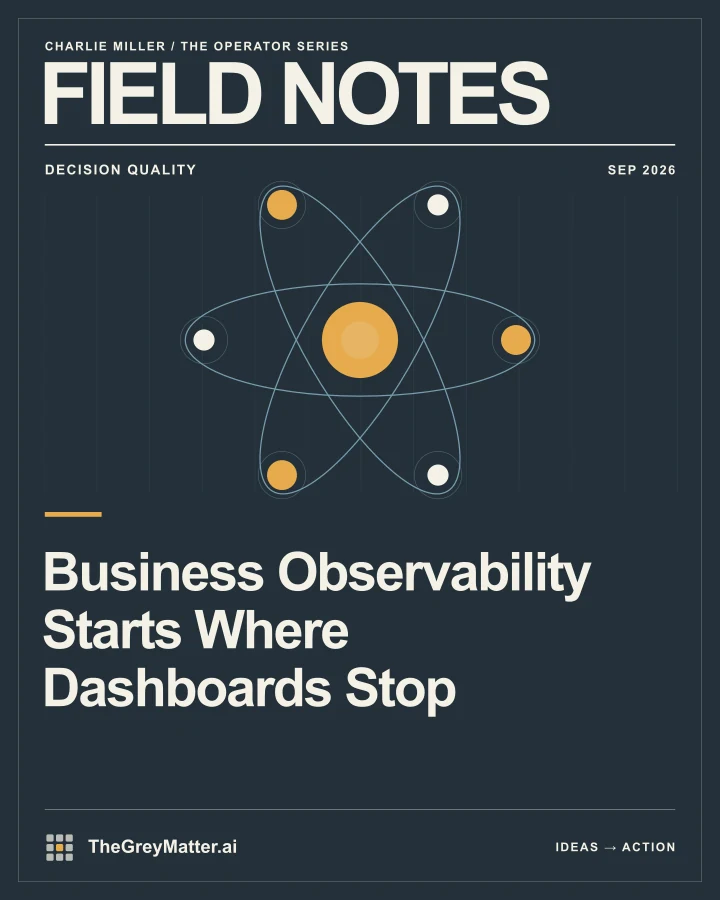
In brief
Business Observability becomes useful when it connects a signal to its causes, consequences, owners, and next decisions.
A dashboard can tell you that a number moved. It rarely tells you how that movement traveled through the business, which assumptions are now weaker, or who should make the next call. Business Observability starts in that gap.
A metric is not yet an operating explanation.
Most reporting systems are built around a local question. Sales looks at pipeline. Finance looks at margin and cash. People leaders look at capacity and retention. Operations looks at delivery. Each view may be accurate while the combined picture remains incomplete.
The operating problem appears when a leader has to explain movement across those boundaries. A margin change may begin in pricing, show up in delivery, pressure staffing, and alter the forecast. Reading each dashboard separately leaves the causal work to the person in the meeting.
Observation should lead to orientation.
Useful observability does more than surface anomalies. It gives the signal business context: what changed, what else moved, which relationship may explain it, what evidence supports that interpretation, and what remains unknown.
That context is what turns visibility into orientation. Without it, a leader is still assembling the business in their head. With it, the team can challenge the same explanation, inspect the same evidence, and decide from a shared picture.
The point is not to see more data. The point is to see the business clearly enough to move.
The unit of value is the next better decision.
A Business Observability system should be judged by the decisions it improves, not the number of charts it contains. Does it shorten the path from signal to owner? Does it reveal the cost of waiting? Does it show which assumption must be verified before capital or attention moves?
This is especially important in private equity and portfolio operations, where the same signal can matter at the company, fund, lender, and board level. The system must preserve the local detail while making cross-company patterns legible.
A practical test for Business Observability.
Take one material movement in the business and ask five questions. What changed? Where did the underlying evidence come from? Which connected function is affected next? Who owns the response? What new evidence would change the recommended action?
If the operating system cannot answer those questions without a manual scavenger hunt, the organization may have reporting, analytics, and AI while still lacking Business Observability.
One useful next step: Choose one idea from this note and test it at the smallest scale that could teach you something this week.