 Vice President · TheGreyMatter.ai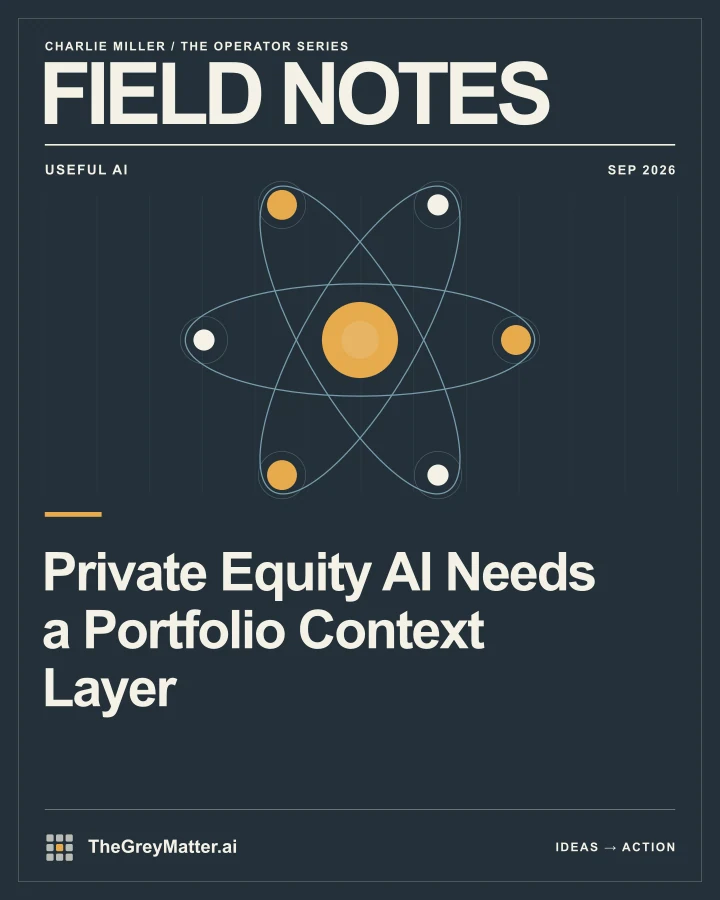
In brief
Private equity AI should inherit a governed map of the portfolio instead of rebuilding context from every prompt.
An AI model can be capable and still be operationally unhelpful. The missing ingredient is often not intelligence. It is the portfolio-specific context required to interpret a number, compare companies responsibly, and route the next action.
A portfolio is not one clean dataset.
Portfolio companies use different systems, naming conventions, operating cadences, and definitions. Revenue may be recognized differently. Pipeline stages may mean different things. Customer health may be measured with entirely different proxies.
If an AI workflow treats those labels as interchangeable, it can produce a polished comparison that rests on false equivalence. The model did not fail at language. The operating context failed before the model began.
Build the map before asking for the answer.
A portfolio context layer connects systems to governed definitions, business relationships, decision owners, and evidence provenance. It tells the AI what a term means here, which source is authoritative, which comparisons are safe, and where uncertainty must stay visible.
That map should not be rebuilt in a heroic prompt every time. It should become durable operating infrastructure: maintained, permissioned, inspectable, and available to every approved workflow that needs it.
Context first. Intelligence second. Action only after the evidence boundary is visible.
The fund view and company view must coexist.
An operating partner needs to see patterns across the portfolio. A company executive needs the detail and nuance inside one business. A useful system preserves both views without flattening one into the other.
That means every portfolio-level observation should be traceable to company-level evidence, and every recommended action should have a named owner in the business where the action will actually occur.
Start with one decision, not an enterprise promise.
Choose one recurring decision with a known owner and a measurable cost of delay. Map the minimum data and definitions it requires. Mark the evidence that is missing. Then let AI prepare the decision while a human remains responsible for the call.
A narrow, inspectable workflow teaches the organization what its context layer must contain. That learning is more valuable than a broad pilot that generates impressive outputs without changing how the portfolio operates.
One useful next step: Choose one idea from this note and test it at the smallest scale that could teach you something this week.